

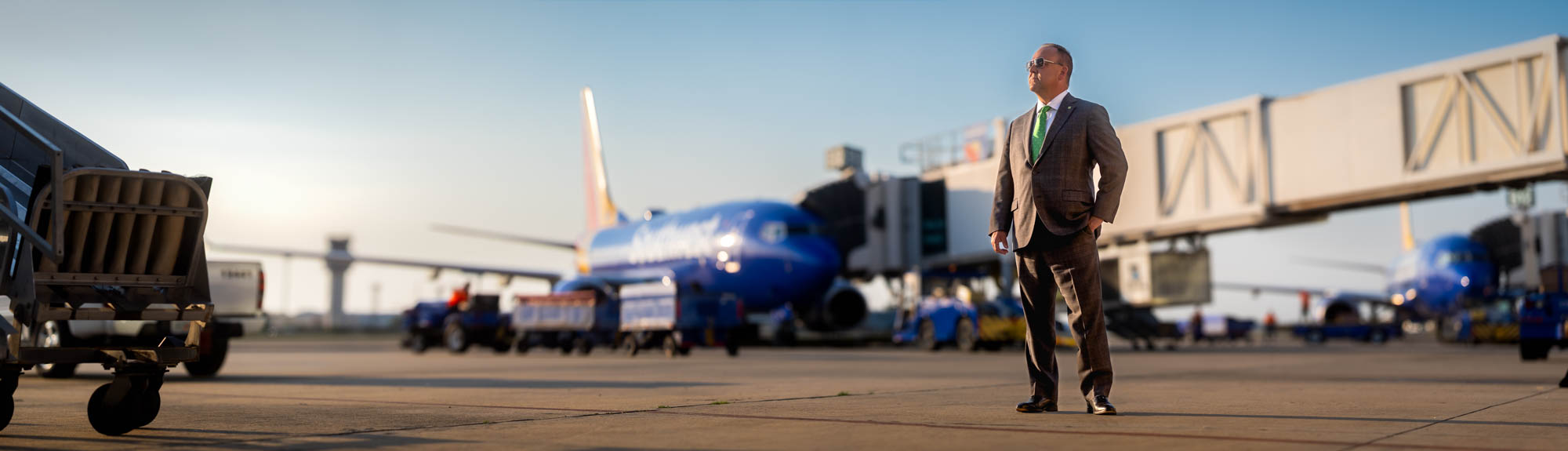
Paul Hoback, Jr., had big shoes to fill. Since 1995, Rick Piccolo had led Sarasota-Bradenton International Airport (SRQ), pulling it from financial mire into a period of unprecedented growth. Hoback, however, was more than ready to take over the reins when he began as president and CEO of SRQ on October 19, 2025. A native of Pittsburgh, Pennsylvania, Hoback spent 25 years at Pittsburgh International Airport (PIT), working in a multitude of roles. Most recently, he was the executive vice president and chief development officer for the Allegheny County Airport Authority (ACAA), where he oversaw PIT’s $1.7 billion dollar new terminal program. Full of warmth, wisdom and Midwest charm, Hoback sat down with SRQ Magazine to discuss how he plans to steward SRQ Airport into its next chapter.
What brought you to SRQ Airport? HOBACK
I’ve had a deep love of aviation since the moment I saw Top Gun. After I graduated from college with a degree in Mechanical Engineering, I started my career with a couple of different jobs. I was a research and development engineer for a window and door company in the Pittsburgh area, and then I was a mechanical engineer for a diaper factory. In 1999, the ACAA was formed, which allowed people who lived outside of Allegheny County—I lived in Beaver County, just west of Pittsburgh—to work for the airport. Because I had this passion for aviation and wanted to be a pilot, I decided to go for a mechanical engineering project manager role at Pittsburgh International and the rest is history. I had 10 or 12 roles in my 25 years at Pittsburgh International, ultimately culminating in me essentially being the number two at Pittsburgh Airport for the past 10 years. I was running the operational side, but I was also the person responsible for building the new Pittsburgh International Airport. That was about a $1.7 billion dollar project to build a new terminal, new roadway systems, new bridges, a new parking garage, a new rental car center and new customer service buildings. That was everything associated with all of the landside functions, then we spent approximately $240 million dollars on renovating our airside facilities. For the past 12 years, that was my planning team that ran point on that and my engineering team that worked on building the new airport, which just opened this past November.
When did you decide that running your own airport was something that you aspired to do? As we were coming up on the completion of that project, I had lots of conversations with my CEO, Christina Cassotis, on what I was going to do with my career—what was next after doing something that in my mind, redefined the airport industry. That’s not because I’m biased, but because I truly believe that the new Pittsburgh airport is very special.
So, how do I top that? Well, I knew that I wanted to run my own airport. I wanted the opportunity to take all of the amazing things that I’ve learned over the past 12 years from Christina and positively impact a team, an airport, a community, because I know how important the airport is to every community out there. In October 2024, I started in a selection process for another airport, Cincinnati/Northern Kentucky International, and made it to the final two and didn’t get the job. That was probably the best thing that ever happened to me, because four months later, I saw that Rick Piccolo was retiring here at SRQ. I looked at the documents they put out on who they were looking for and it felt like every single thing I read was pointing to them wanting someone just like me, with the experiences I’ve gained.
Because SRQ has seen such significant growth, they knew that they were going to have some pretty significant capital programs coming up in building a parking garage, a rental car center and various other facilities. Rick and the team have done an incredible job trying to keep up with that growth and yet there’s still more to do—I look at that not as a problem, but as opportunity.
I also had ties to this community. I grew up visiting my grandmother who lived in Zephyr Hills and my uncle who lived in St. Pete and vacationing in Siesta Key. My sister has lived in the area for many years. When I started to do more research about the Sarasota-Bradenton area, I started seeing all of the connections to the Midwest—I characterize Pittsburgh as a lot more Midwestern than Northeastern—there’s a friendliness where everybody cares about each other and I get that same feeling down here. Even as you drive around during snowbird season, you’ll see license plates from Indiana, Ohio, Michigan and Pennsylvania. I couldn’t have picked a better location, a better team, a better airport or a better region to take on the responsibilities as CEO of an airport. It’s truly an honor to be here.
What were some of those qualities that SRQ was looking for in a CEO that you saw in yourself? One of the most important things that I saw was the idea around servant leadership. When you look at the typical organizational chart of a company, the CEO is at the top. I very much believe that should be flipped. I am here as the CEO to serve the people and eliminate roadblocks. My role is to see around corners and not just straight down the runway. Establishing a culture that works, so that I can take away the roadblocks from my people on the front lines that are truly taking care of the customers, our airlines and our tenants here.
When you see these documents of what a potential airport looks for in its CEO, rarely do you see the words “servant leadership.” That struck a chord with me. I felt like Rick led this team and this airport from a servant leadership perspective, which is why I felt like that was the most important quality that I could offer as CEO.
How would you characterize the current era that SRQ Airport finds itself in? Is it still an era of explosive growth or is it one of managing change? Passenger growth has slowed significantly. Between 2018 and 2023, our passenger numbers exploded—we went from 1.3 million in 2018 to 4.3 million passengers in 2023. From 2023 to 2025, it’s grown from 4.3 million to 4.5 million passengers. Now, we have to look at strategic growth as we continue to grow capacity in our facilities—what are the markets we want to target and where do we want to grow?
There’s certainly an opportunity on the West Coast. We currently don’t fly past Denver. There are markets like Phoenix, Las Vegas, Los Angeles that we have to take a much closer look at. Since Sarasota is an up-and-coming tech community, should we have direct flights to San Francisco International Airport and Silicon Valley? In the next three to five years, there’s an opportunity to grow our international service. We’re also always going to be looking at potentially underserved markets in the Midwest and Northeast, like Milwaukee, Tulsa and New Orleans, which we currently don’t have service to. Because of some of the facility concerns we’ve had over the past couple of years, the number one priority was making sure that we had enough passenger gates. That’s why the focus was on the new ground boarding facility that opened up last year, which Allegiant Airlines operates out of. The next phase of that is addressing the capacity concerns, such as parking, rental car opportunities and the baggage claim system. We only have three baggage claim devices and have six airlines, potentially during peak times, that need to unload on those devices.
For 90% of the year, we don’t have problems with parking or curbside pickup or our rental car facilities. During those peak travel times, which is 10% of the year, we have those concerns. As we continue to grow, we’re going to see that 10% become 20% or 30% of the year, which is why we have to address those capacity concerns right now. We will be moving forward with designing a new parking garage and designing a new rental car center. In most airports, the main non-aeronautical revenue source is parking. At SRQ, it’s rental cars. It’s not that we don’t have enough rental cars right now, we need bigger facilities to store the cars and that are more efficient in their turnaround time.
What were your first impressions of SRQ Airport? I truly believe that the best airports reflect the soul of the community that they are serving. That is what I found that SRQ does best. This region seems to have what I know to be that Midwest charm. Being from Pittsburgh, I always thought of Pittsburgh Airport as being the friendliest airport. When my son chose to go to Arizona State, I began to fly into Phoenix Sky Harbor International Airport quite often. It would always make me angry, because Phoenix’s motto is “America’s Friendliest Airport,” and I thought, no, Pittsburgh is the friendliest airport.
Then, when I started to fly into SRQ during the selection process, I’d never experienced anything like it. The atmosphere at SRQ felt different; it felt real. From the airport employee to the airline employee to the TSA contractors and cleaning crews, it feels like every single person cares about you. That’s how I feel about this region. It is the soul of a community that is being reflected inside of an airport. That hospitable feeling that you get when you walk into SRQ Airport is the special sauce that this airport has to offer and is what I have to embrace and try to make better as we continue to grow.
The soul of the airport is in that boutique, family feel, but we have some opportunities to make some improvements to the aesthetics of the space that will bring everything together. This area is an absolute paradise with so much to offer, with an incredibly rich arts and culture scene, amazing restaurants and of course, the beaches. There needs to be a sense of place here at the airport from an aesthetic perspective. I don’t want the airport to be a point of someone’s travel when heading to a destination. I want the destination to be represented right here.